
A Polymath Renaissance
The hope of universality

When we hear the word ‘polymath,’ we tend to think of ancient sages like Archimedes and Aristotle, or ‘Renaissance Men’ like the archetypal polymath Leonardo da Vinci. All these figures loom large in our minds; paragons of excellence from a time when it was possible to juggle several areas of expertise at once, and to be top of your game in all of them. To be an astronomer, a philosopher, a linguist, artist, and composer, all in one lifetime.
Nowadays, we seem to implicitly consider that such multi-faceted virtuosity is no longer within reach. In the words of political philosopher Judith Shklar, we have now passed into a “fragmented world of knowledge… the hope of universality has gone forever.” It no longer seems feasible to read through all the available materials in any given academic field, never mind several fields, and never mind cultivating high level skill in the arts alongside. Scholarly excellence is now associated with hyper-specialisation instead, and academics corner themselves into ever narrower boundaries of enquiry, working on minutely niche topics and striving to be an authoritative voice therein.
In his essay The Polymath in an Age of Specialisation, Peter Burke identifies three “crises of knowledge” since the end of the Middle Ages; the first being the Gutenberg printing press revolution, the second being the rise of cheap mass-market printing during the Industrial Era, and the third being the latter half of the 20th century, in which the phrase “information overload” was coined. In each crisis, the torrent of information has overwhelmed us and caused us to retreat further into specialisation, and further away from the polymathic ideal.
When Shklar wrote that the hope of universality had gone forever, in her book After Utopia, it was the 1950s; the same decade that Burke identifies as potentially being the final decade to produce any polymaths. The third crisis of knowledge irrevocably fragmented learning, and hot on its heels has come the fourth crisis, the most devastating yet. In this last phase of the cumulative deluge, we face not merely an overwhelming quantity of information from the minds of other people, but from the imitative mind of artificial intelligence, which proliferates information with such force that no amount of specialisation can shield us from it. The hope of universality is dead, and AI is dancing on its grave. But AI’s seeming breadth is no replacement for human versatility, and in reality is a poor imitation of universality. It is separate from the human dream that once made that concept meaningful, and crucially, the fact that AI can produce information does not mean that it is capable of transforming that information into genuine knowledge or wisdom, or of making any truly original contributions.
That is the role of the human polymath. To be a true polymath, it is not enough to merely know things. You could know everything and understand nothing. The great superpower of the human polymath is their ability to connect the things they know; to notice links between topics that others have kept separate, and out of this betweenness to forge ahead into uncharted intellectual and creative territory. In the words of Nicholas Carr in his essay Nasty, Brutish and Dim: Online Life Reconsidered:
It’s these connections, or associations, between pieces of information, not the individual pieces themselves, that give depth to our thoughts. The connections form the essence of our intellect, enabling us to think conceptually and critically, to solve difficult and unexpected problems, and to make leaps of inference and imagination. The richer the web of connections, the sharper the mind.
In a world saturated with information, we risk permanent cultural stagnation if we do not respond with a fresh wave of polymathic renewal. After the printing press, came the Renaissance. Now in the age of artificial intelligence, the time has come for a new Renaissance of human intelligence, and a new generation of polymaths…
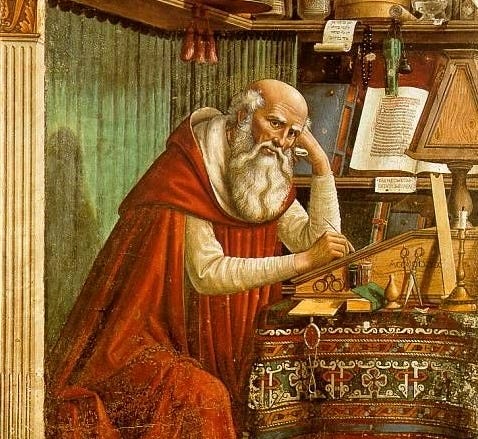
Halls of wonders and cabinets of curiosities
The renowned Jesuit polymath Athanasius Kircher, the “Master of a Hundred Arts,”founded the first ‘cabinet of curiosities,’ or ‘hall of wonders’; a public collection showcasing interesting artefacts and antiquities. Objects of art, anthropology and natural history jostled alongside each other in a spectacle of fascination, and the concept spread, eventually developing into the modern day museum.
In the new Renaissance, you must curate your own cabinet of curiosities. Your cabinet may be externally expressed (my own collection in my bedroom includes an assortment of shells picked up on copious walks at the beach, many second-hand and antique books from charity shops, and a gallery wall of posters and postcards with my favourite artworks). Most of all, though, you must curate a mental hall of wonders, intentionally filling your mind with curiosities. Advice for autodidacts will often recommend creating a curriculum, but sometimes we are so conditioned by the ways we were expected to learn at school, that we psychologically remain trapped inside the very system we are trying to evade. By all means, look up university curricula for subjects you want to study, and utilise some of the recommended materials. But also read that out-of-print book on comparative religion that you found in a box at the market. Read your grandmother’s old botany guide. Seek out curiosities without feeling the need to slot them into a regimented plan.
AI is predictive, drawing its answers from the most frequent results in its dataset. Strive to make your brain’s dataset more surprising than AI’s. Look out for anomalies that fall outside AI’s scope. You’re the head curator of your own hall of wonders, and you make it interesting by allowing yourself to deviate from pre-trodden paths. Polymathy means approaching the world in new and original ways, driven by your own quest for answers and meaning. Perhaps there are certain themes or threads of interest that drive your search, which you can use to traverse different areas for unique perspectives. In Elif Batuman’s novel Either/Or, the main character Selin, a student at Harvard, muses on the seemingly arbitrary categorisation of academic subject areas and wonders why universities don’t have a department of love. Her own search takes her from Kierkegaard’s philosophy to Pushkin’s poetry, each new reading adding to her overall mental picture and allowing her to develop more complex thoughts.
An essential feature for the preservation of your cabinet is memory. In a recent address at Pusey House in Oxford, Mary Harrington discussed “memory palaces,” and the way our memories have been gradually eroded since the arrival of the printing press (neatly fitting in with Peter Burke’s assessment of this time as the first crisis of knowledge). Memorisation is often derided in modern educational thought, but being able to recall historical timelines or lines from Shakespearean sonnets will furnish your mind with resources and frameworks which will enrich its ability to make disparate connections. Harrington calls for a rebuilding of medieval practices of memory, and renewed efforts to build our own mental algorithms instead of passively relying on machines to serve us content. The polymath is not a passive receiver of information; the polymath is an active seeker of knowledge.
It is perhaps unsurprising that many polymaths in history lived monastic lives. The medieval nun Hildegard of Bingen, for instance, wrote works of theology, medicine, and botany, composed music, created poetry and works of art, and even invented her own language. The monastic conditions of time and silence allow not only for extended study, but for extended contemplation; for ideas to percolate and take shape in the mind without distraction. It is no wonder that our modern age fails to produce polymaths, defined as it is by abstraction, fragmentation and detachment - the very antithesis of monasticism. Modern attempts to regain mental clarity can be seen in the profusion of self-help books, minimalism and learning trends, but these can themselves often be a distraction, and are devitalised of the worldview that underpinned the monastic life and gave it vision.
In Nicholas Carr’s aforementioned essay, he discusses how the barrage of information online breaks our concentration and fractures our attention, with apps carefully designed to encourage “continuous information snacking and to discourage any sustained mental focus.” Memory and focus are essential components of the polymathic brain, but are obstructed by the experience of being online:
The paradox of digital media is that, even as it provides us with broader and faster access to information than we’ve ever had in the past, it dispenses the information in ways that impede the fundamental brain processes required to build personal knowledge. More information, we’re now learning, can actually lead to less knowledge.
While the internet undoubtedly has its uses, I believe that the new Renaissance will have to create some distance from it. Screens are not conducive to deep reflection, active memory, or even mental agency. Over-reliance on AI restricts your brain’s scope for independent reasoning, and limits the input your brain receives to AI’s own dataset - especially concerning given the phenomenon of AI “hallucination,” whereby large language models like ChatGPT generate false or misleading responses instead of admitting when they don’t have a reliable answer to something. Polymaths must nourish the idiosyncrasies of their minds, must cultivate their memory, and must allow their brains to wander…
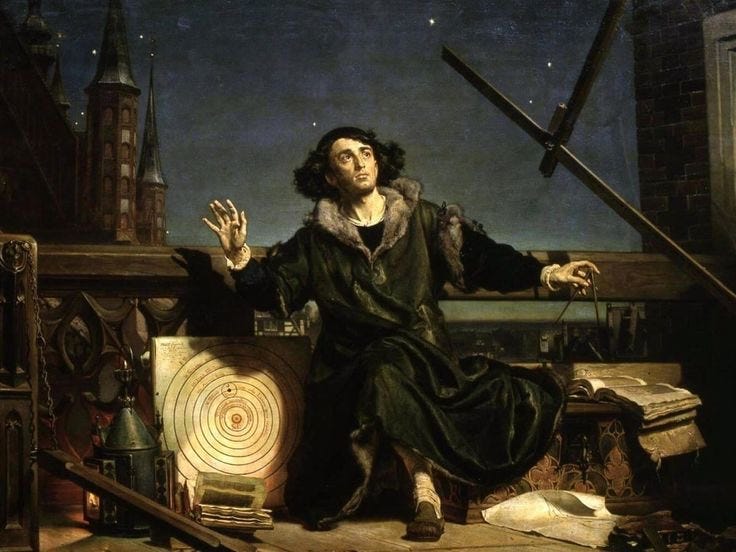
Against epistocracy
An academic system built around specialisation is necessarily hierarchical. Formal academia resembles an epistocracy, meaning “rule of the knowers.” Experts at the top hold the niche knowledge of their field, and disseminate what they know to those further down the ranks via teaching and writing. Without denigrating expertise itself, universities wielding experts as part of their business model causes knowledge to often become commodified - as Erica Benner put it in her essay Knowledge Without Authority, epistemic authority-dependence “takes the form of a commercial transaction where both buyers and sellers treat knowledge as a kind of merchandise.” In countries like Britain and the USA, knowledge quite literally becomes a commercial transaction, with students plunged into eye-watering debt in order to obtain a degree.
As such, authoritative knowledge is something that “belongs” to professional academics in many people’s minds. Credentialism requires us to climb the ladder of university degrees in order to have our knowledge taken seriously. In this hierarchy, knowledge is a status symbol, verified by titles and certificates. There is an expected level of deference to the authority of the academic elite, such that many people are, in Benner’s words, “complicit in their own mental subjection” through over-reliance on those who wield the most power within the system. This mindset is now extended even to technology, with many people deferring to answers received from artificial intelligence, assuming that its technological status makes it superior to our own human brains. The CEO of OpenAI, Sam Altman, openly supports this system of dependency, and has said that he envisions a future where intelligence is a “utility” like electricity or water - something ordinary people have to pay for and receive from higher powers.
This mindset is clearly at odds with the brain of the polymath, which can be neither restricted nor subordinated in the way that epistocracy demands. Fundamentally, polymathy is not something that can be “achieved” in the standard sense of working towards a qualification or passing a certain checkpoint. Rather, I believe that we should conceive of it as an approach to life, and one that is not limited to an elite group of people or to isolated geniuses. If we are to revive polymathy for a new Renaissance, we must encourage ordinary people as well as professional academics to have the confidence to widen their scope of intellectual and artistic exploration. We must escape the constraints we put on our minds, and the supposition that knowledge must always be validated by external approval.
Fixation on credentialism also has the effect of making education utilitarian. Knowledge is no longer seen as valuable in its own right, but becomes a means to a (usually monetary) end. Tell people that you study business and they will nod with approval; tell them you study history and they’ll ask what you’ll use it for. This mindset may also be linked to our collective reduction of memory - if knowledge isn’t housed in the mind, we feel that it must be channelled into a product, with the end result that knowledge itself becomes a product. Knowledge should not have to prove its utility in ways that it can be capitalised; its usefulness is embedded in its own intrinsic quality.
Polymathy as an approach to life liberates knowledge and creativity from structures that limit them, and liberates people to pursue their curiosity no matter the contexts of their lives. Education has often been seen as a luxury or privilege, but as an approach of enquiry it can be integrated into life more broadly. Historical polymaths including Socrates, Francis Bacon and Thomas Hobbes believed that one of the best forms of education is dialogue, with friends and equals as well as with experts. Discourse and synthesis within one’s own mind, and between different minds. As a bee settles on all flowers and takes the best from each one, said Isocrates; “so also those who desire an education must leave nothing untasted but must collect advice from every source.” Having an unconventional educational background does not have to be a restriction; it could actually enhance your unique approach. If you are outside the university system, it does not mean you are exiled from academia. Write to professors when you have questions about their work. Look out for lectures and seminars and other events that you can attend as a member of the public. There are many more possibilities out there than people tend to realise.
The hope of universality, then, is not the hope of domination across all fields, but of dialogue and harmony between them. The very word “university” is suggestive of a universal vision of education, one that draws scholars and ideas together in pursuit of the Truth. In The Idea of a University, John Henry Newman articulates this vision, as:
…true enlargement of mind which is the power of viewing many things at once as one whole, of referring them severally to their true place in the universal system, of understanding their respective values, and determining their mutual dependence. Thus is that form of Universal Knowledge… set up in the individual intellect, and constitutes its perfection. Possessed of this real illumination, the mind never views any part of the extended subject-matter of Knowledge without recollecting that it is but a part, or without the associations which spring from this recollection. It makes every thing in some sort lead to every thing else; it would communicate the image of the whole to every separate portion, till that whole becomes in imagination like a spirit, every where pervading and penetrating its component parts, and giving them one definite meaning.
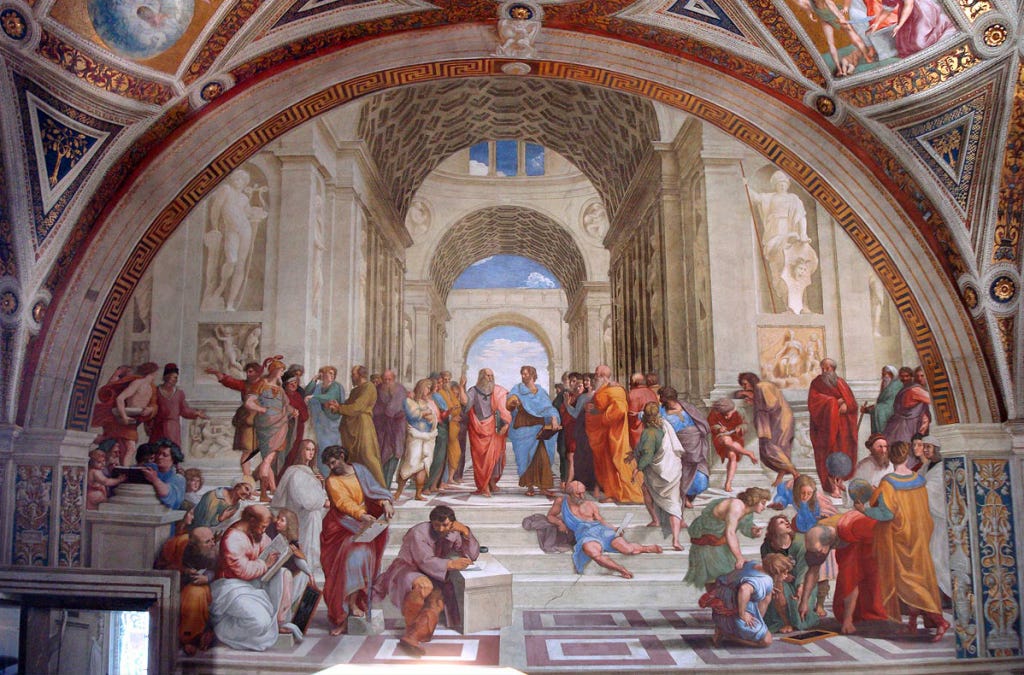
Conclusion
Rather than feeling discouraged by the successive crises of knowledge, I believe that the latest iteration of “information overload” should only give us fresh determination to expand our own minds, and to seek out new connections and original ways of understanding and responding to the world. To hold on to our humanity and the depths that human consciousness alone can reach. To this end, there is the possibility, and the need, for a new Renaissance. The sense of yearning that we feel when we look at great artistic and intellectual feats of past ages, does not have to be trapped looking backwards. A new generation of Renaissance men and women might yet rise up in the world and reignite the hope of universality, in defiance of modernity’s inhospitable conditions.
The new polymaths will have to be prepared to step out of conventional lines, both in their dealings with knowledge and in their pursuit of it. To ask questions that others have side-stepped, and to connect things previously kept separate. To probe all possibilities and to engage in many dialogues. Like Isocrates’ bee, the polymath must be able to rove across different domains, synthesising their insights from different sources into an increasingly holistic vision of the world. To be a “generalist” may sound shallow to some, but polymaths can be selective even as they are expansive, discerning where to focus their intellectual energy in pursuit of cohesive understanding and personal fulfilment. Life is greatly enriched by multi-faceted passion, and perhaps many more connections might be made across academia and the arts - and in our everyday lives - if more people embraced the approach to learning of history’s great polymaths.
Wonderfully written. Indeed, our desire for a new Renaissance has to originate in ourselves and in looking at our world as a whole, not as just a collection of soundbites and information to be filed away.
The dimension of personal development and intrinsic quality of true knowledge is one that is rarely emphasised today as well, as it leaves virtue of Wisdom untouched - having a piece of information and knowing what to do with it, but also when, is what we have very little of.
Thank you for this fine essay! "Having an unconventional educational background does not have to be a restriction; it could actually enhance your unique approach"—I have experienced this in my own life. I studied applied math and physics as an undergrad and ended up with a PhD in literature, and I have often noticed how those disparate fields of knowledge combined energetically and fruitfully in my work as a literary scholar.